It's been way too long since my last post.
There was no time or brain space to blog. The only important thing became being with a family member who was fighting the good fight against cancer.
Since my brother-in-law's death, it has become even more clear to me how important empathy truly is to the spirit. True suffering is the feeling of being alone.
Feeling alone is how children/teens feel when they have been belittled and demeaned and no one seems to care. It's a feeling they don't have to have. It's grief for an irrational reason.
For anyone who has had this feeling of loss, I think you'll agree that a little empathy goes a long way.
There are many ways to nurture empathy in children -- just ask the Kid President (Robby Novak). Kid President's Guide to Being Awesome has 100 ideas on how to make the world a better place. If you've never checked out the Soul Pancake's Kid President videos, they're just the perfect thing to inspire empathy and action while making you and your kids have a laugh and a reason to dance.
Empathy is everything, especially when you've lost your reason to dance.
Showing posts with label bullying. Show all posts
Showing posts with label bullying. Show all posts
Wednesday, February 24, 2016

Tuesday, July 15, 2014
The Silent Soul Crusher of #Bullying

Sometimes it's not the words that hurt, it's the shrug of the shoulders, it's the no eye contact, it's the looking through a person and not at them. It's the absence of words.
Message is received. You're not important. Your heart shrinks a little more. Kids know when their peers or even adults are not that interested in them. It's like the title of the book and movie by the same name, "He's Just Not that Into You."
This is something that has to be experienced to understand. And that's really part of the harsh reality. Often this is a silent soul crusher because the method of hurting another is off the radar. No one sees it. It's no big deal to others. It doesn't matter. There is no recourse. It is isolating and there is no road map.
No child should feel alone. Correction. No person should feel alone.
Kids don't read this blog so if you're an adult who is made to feel small by being made to feel invisible, please know that your suffering is real. Although we probably have never met, I am sorry if you are feeling diminished in any way.
You are important and fight for yourself. Get new friends. Seek new circles and perhaps look out for a child who may be feeling the same way. See them. Validate their importance.
Your interest is proof of how important you are. Sometimes it just takes one person to remind a child of their value. You won't know it by their words but you'll see it in their eyes.
My hope is that you are seen and appreciated today.
Thursday, July 3, 2014
Chain of Leadership as the Anti-Bully

The 2013-2014 school year was full of light bulb moments.
It started out with this thought: What if we gave young students the chance to shine as leaders? What if we spent as much time creating opportunities for them to practice their leadership skills as we did talking to them about bullying? What if we got a little creative? What if we could inspire the adults and the kids without it being a hassle or taking away from class time? What if we made it inexpensive? Simple? Flexible? And dare I say, what if it was fun?
The answer was One Can Count, based on Kathryn Otoshi's award-winning book, One, and thanks to Senator Lanza, we were able to answer some of those burning questions.
It is the first time that all 30 elementary schools in Senator Lanza's Staten Island district received the tools they needed to start their own One Can Count initiative. It became a chain of leadership. From the free workshop in September to the last day in June, schools made One Can Count their own. Parent coordinators, teachers, principals and counselors embraced the concept that leadership is the anti-bully.
Here's the simple theory: Kids need attention. They'll get it any way they can. So, if you give them the chance to be their best self, they most often rise to the occasion. The more leaders you have in a classroom, the better the balance.
Although it's a children's book, every age, including grown ups are inspired by the power that each of us has to stand up and be the One that steps in.
One Can Count is designed to be a stand alone initiative or work with existing programs in the school to help children value the concept of respect. Bullying is a tangled ball and just like any messy and complicated issue, it often requires many small solutions.
With that being said, I was amazed at what schools accomplished this year. They took this tool and ran with it. They had mentoring programs, art and writing projects, assemblies, leadership counsels, performances, and much more. They created daily reminders of what it's like to be a One.
The year started out with questions but it ended with an answer:
Words of a 5th Grade Leader presenting chain of leadership to Senator Lanza:
Just like the chain, we are connected to one another in our commitment to grow into young leaders. We are a community of learners who recognize that leadership is not just a position, but a process. -- PiumiPart of that process:
Books and Materials
Multiple copies of One and the companion book, Zero, were delivered to each of the 30 schools in early September.
Workshop
With the generous support of St. John's University, schools came together to hear from experts, including author Kathryn Otoshi and to discuss ideas in which schools could easily incorporate the concepts of leadership.
Free Materials
Materials to help get the tangled ball rolling are free and downloadable here.
Creating the Concept of a Team
Schools had the option of ordering special personalized One Can Count t-shirts for students or teachers.
We're just getting started. Next year our goal is to have every student feel like a leader. -- Parent Coordinator, P.S. 80
Sometimes it just takes One.
Thank you Senator Lanza, St. John's University, Kathryn Otoshi, and especially schools, for delivering hundreds of light bulb moments for me and hopefully Staten Island elementary school students. Looking forward to 2014-2015.
Thursday, March 27, 2014
P.S. 45 Takes "Respect For All' Seriously All Year Long
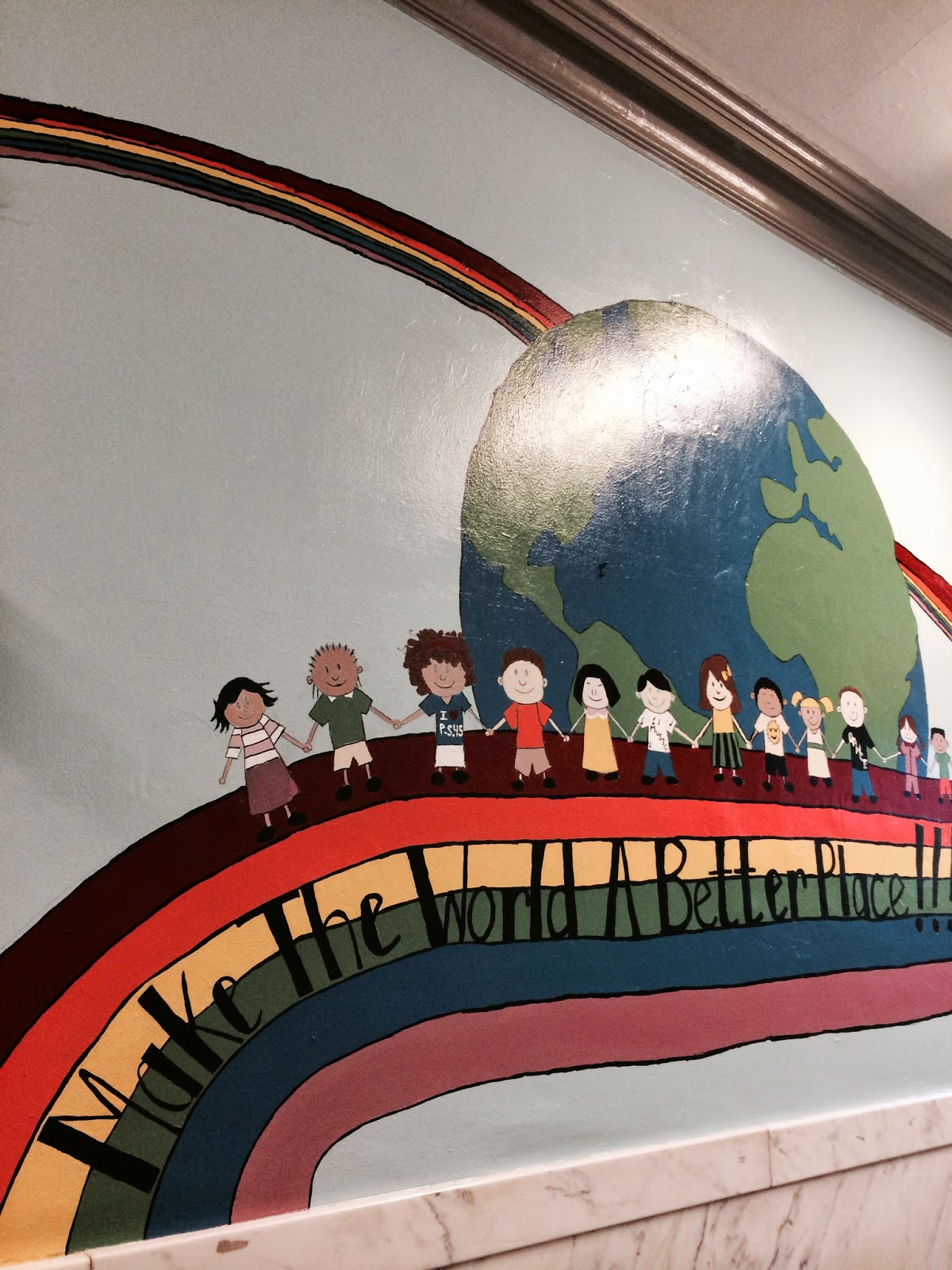
Visiting Staten Island's P.S. 45 (John Tyler School) inspired me. (For those reading this outside of New York City, P.S. stands for Public School.)
Every student in this elementary school participated in an awesome kick-off assembly honoring Respect for All Week. The students were led in a special reading of Kathryn Otoshi's book Zero by a group of their peers involved in the SOAR program. (To facilitate character building, New York State Senator Andrew Lanza sponsored One Can Count in all the elementary schools in his district. Multiple copies of One and Zero were provided to each school.)
According to guidance counselor and SOAR mentor Libby McPike,
SOAR stands for Safe Organized Attitude Respect. It's our school wide positive behavior model. Kids follow these expectations and when caught doing well, can be rewarded with eagle dollars (eagle is our school mascot). Then they shop in the SOAR STORE for items anywhere from erasers to DVD players (all run on donations).
P.S. 45's approach to teaching respect and character education is one more example to me that "leadership is the anti-bully." And sometimes teaching leadership takes a bit of creativity. Ms. Libby and her students have plenty of that to share. Here's just a snippet of the kind of activities that this dedicated professional and the students she mentors have developed to engage the entire school -- staff and students alike -- in the empowering messages of kindness, tolerance and respect.
Monday:
Wear Purple: Purple is the color of good judgment. It is said if you surround yourself with purple you will have peace of mind. Purple is a good color to use in meditation. Purple has been used to symbolize magic and mystery, as well as royalty. Being the combination of red and blue, the warmest and coolest colors, purple is believed to be the ideal color.
Activity: Good Deed CatalogIt goes without saying that it’s important to teach kids to do nice things for one another. During Respect for All Week, keep a running tally of good deeds that students perform. These can include helping clean up, consoling a sad classmate, sharing, helping out a friends, etc. Tell your class that if they reach a certain number of good deeds for the week, they will receive some sort of prize (Ex. Lunch with the teacher, homework pass, Good Deed Certificate, Etc.)
On the day I visited, the gym it was an enthusiastic sea of purple.
After reading the book, the group of SOAR students (as young as 3rd grade) led the entire school in a question and answer session based on the themes of Zero, including "What does it mean to have a hole in your middle?" and "How did it feel to have the other numbers step up?".
5 Things I Learned at P.S. 45
• A thoughtful, creative and enthusiastic administration is the foundation for promoting high quality character education. (A shout out to principal Ms. Chavez and parent coordinator Mrs. Poli who allowed me to be there and so graciously welcomed me to their school.)
• It's a worthy commitment to create an environment where leadership is part of the culture year round.
• Helping students develop leadership skills such as public speaking gives children confidence and confidence is the key to resilience.
• When students are expected to listen to each other and value each person's opinion, they rise to the occasion. (Note: Amazing how many students were eager to be a part of the question/answer session. The students obviously felt safe to share their opinions with a gym full of their peers.)
• The students had fun. Teaching children to step up helps children SOAR and it's never boring.
(Speaking of "stepping up," Ms. Libby went the extra step and wore purple shoes!)
Teaching leadership and respect takes a lot of hard work. Mentoring children is exhausting and never a perfect process. For those reasons, I am deeply grateful for the fine professionals at P.S. 45 and other schools around the country who hang in there every day and give it 100%. You deserve a parade.
Thank you.

Thursday, January 23, 2014
Getting Creative and Teaching Leadership at P.S. 55

Fifth graders are the experts as they partner with the Kindergartners to reinforce the message, "Everyone Counts." After reading Kathryn Otoshi's award-winning book, One, the mentors got together with their younger counterparts to lead them in an activity that demonstrates that everyone is unique, beautiful and valuable. (One is an ageless children's book which beautifully and simply inspires kids -- and adults, too -- to step up for themselves and for others.)
A One Can Count team of teachers and staff came up with the idea of doing something seasonal that expressed the importance of respecting each other's differences. As the partners created their own snowflakes together, the students had fun getting to know one another as well as crafting something that they could display with pride.
There are so many positive things about P.S. 55's efforts.
Using a Simple Tool
NYS Senator Andrew Lanza provided 30 copies of One and 30 copies of it's companion book, Zero, to each elementary school in his district on Staten Island. Inspired by the book and the gift, P.S. 55 set out to ensure that each student received their own personal copy of One.
Mentoring
The message of One is for all ages but when you make the older students the teachers, they take ownership of the concepts of kindness, empowerment, and positive action. There are countless benefits of mentoring but perhaps placing students in a leadership role is the most powerful. Leadership is the Anti-Bully.
Staff Involvement
When administration, teachers, guidance counselors, parent coordinators and other staff members get together to promote leadership, it's a message to students that they're important. In essence, it demonstrates leadership and students learn by example.
Enthusiasm
Think about it. Children learn more when they feel emotionally safe and when they're having fun. The fact that Kindergartners have a friend in the 5th grade is a big deal. Add to that, the time spent doing a creative activity brings joy to both.
Compassion
Empathy is easier to teach when students are asked to look out for someone younger. Compassion helps students become "upstanders," the secret weapon against bullying. When kids step up for one another in mean situations, the bullying stops in seconds.
Hats off to Principal Sharon Fishman, Guidance Counselor Arlene Donnelly, staff members Juleah Bracker and Julia Lucchese and of course and most importantly, the brilliant students at P.S. 55. Getting creative and teaching leadership helps create a school climate of cooperation.
In other words, P.S. 55 itself is like a snowflake -- unique and beautiful.

Wednesday, January 8, 2014
Inspiration at the 7-Eleven: #Leadership

When we tell people to do their jobs, we get workers. When we trust people to get the job done, we get leaders. -- Simon SinekI've been lucky enough to hang out in San Diego for the past month. I have my new granddaughter, Lucy, to thank for keeping me out of the harsh NewYork cold.
My daily routine includes getting up early and going to the 7-Eleven on the corner of Beech and State to get a cup of coffee and it always includes nice conversation with the people working there. For example, early Christmas morning, I happened to ask the cashier how his Christmas Eve had been and then he gave me the most spiritual description of Midnight Mass at St. Paul's Cathedral. He was so peaceful telling me about the music and the lighting of candles.
It seemed as if he was totally in the moment and appreciating every aspect of life. It suddenly dawned on me that if he was at Midnight Mass, he must have only had a couple of hours of sleep. He happily told me that four hours of sleep was fine and he was able to get off in the afternoon to celebrate the holiday with his family. Not one complaint. Not one.
I don't know what it is, but every employee there is exceptionally nice. They're not just nice to me. A handful of homeless individuals frequent this store -- begging outside on the corner before they go in. They are also treated with kindness.
It's gotten to the point that if I'm feeling a bit blue or sleep deprived, I look forward to going in there for a boost. And it's not the caffeine because I only drink decaf.
It's a culturally diverse group of employees but they all seem to have one thing in common. They know how to treat people and seem to be genuinely interested.
As I was fumbling around with the simple but complicated process of pouring that first cup, I asked the 20-something guy who was efficiently restocking creamers, if it was a good day. "It has to be," he said. I wasn't 100% sure of what that meant so he explained, "It's my choice to make it a good day and so it has to be a good day." And by making it his choice, he made me aware that it was up to me, too.
As I was leaving, he said, "Have a good one." And I replied, "Now I will."
Leaders work everywhere and do every type of job. Doing a good job takes commitment and a positive attitude.
Good lessons for our children. (And speaking of children, there's an awesome woman there who has 5 children, two grandchildren, and looks 20 years younger than her actual age and I think it's because she has an optimistic attitude!)
Look for leaders wherever you go. You can even get inspired at a 7-Eleven.
Wednesday, December 11, 2013
Leader Nelson Mandela Was a Child Once

What counts in life is not the mere fact that we have lived. It is what difference we have made to the lives of others that will determine the significance of the life we lead.” — Nelson Mandela
Second grader Christian Bucks from York, Pennsylvania, noticed that some kids feel lonely at recess. Although, just the mere mention of recess for most children brings on euphoria, for many others, it's not so fun. When children don't have anyone to hang out with, or worse, if they are a target for mean behavior, it feels long and uncomfortable.
Christian's simple solution? A buddy bench. His 7-year old instincts told him that everyone needs a safe place.
The second story is about Gabbie, a young girl from Greenwood, Indiana, with a big heart and big challenges. Gabbie suffers from a genetic disorder, neurofibromatosis, which causes tumors to grow on the nervous system and can lead to learning disabilities. The disease can mimic autism and result in a degree of social awkwardness. As she became older, Gabbie started to become aware that she wasn't included in social activities, including getting invited to parties.
Heartbroken, Gabbie's mom made an online appeal through Monkee See-Monkee Do for people to send Gabbie cards. What happened next gave me hope that there are many little leaders out there. Gabbie received hundreds of cards from adults and kids cheering Gabbie on and making her feel loved.
It was a gift for both the receiver and the giver. Encouraging children to step up for others is a tremendous lesson. To all the parents who told their children this story and pulled out the paper, pens, glue and glitter to help them write a card to Gabbie, way to go.
We have the chance to nurture great leaders.
"Sometime It Just Takes One."
Friday, November 15, 2013
Principals Have the Power to Encourage Leadership: The Anti-Bully

Leadership is not a rank or a position. Leadership is a service to be given. -- Simon SinekLeadership comes in all sizes, shapes, colors, and ages. That's the message being given at P.S. 23, a wonderful elementary school on Staten Island that I recently had the privilege to visit.P.S. 23 takes leadership seriously. As part of The Leader In Me program, each student from Kindergarten through 5th grade is taught the 7 Habits of Highly Successful People by Stephen R. Covey.Often when I walk into a school and see motivational messages on the walls, I think, "that's really nice"...but do they actually promote this to the students in a more meaningful way? Well, I got my answer during the assembly that I led about One Can Count. (Thanks to Senator Lanza for making One Can Count available in Staten Island elementary schools.) When I asked questions about respect and stepping up for one another, I got answers like "Seek first to understand and then be understood." Or "it's about trust." These are sophisticated concepts for such young students, but kids are smart and when you treat them like they are, they rise to the occasion.Before the principal, Mr. Paul Proscia, introduced me, he spoke with the children first. He set it up by reminding them that they are all leaders. (By the way, he was not talking to them like children. He was talking to them like intelligent adults in the making. It was a sea of little faces but their brains were active and engaged.) He is helping them change the perception of leadership by explaining that leaders are everywhere -- as construction workers, business people, police officers, teachers, nurses, cafeteria workers. "The president is a leader but you don't have to be president to be considered a leader."
Sound simplistic? It's not. These are messages every 5 year-old and up needs to hear in school. Each child needs to be seen, heard and given the feeling that their unique personalities and talents make them leadership material.
At P.S. 23, they are given the opportunity to be leaders, including being a "Leader of the Month." The rubric that decides if you get this honor is not based on grades. It's based on showing respect, helping others, academic effort and using their talents in productive ways.
Mr. Proscia made One the Book of the Month for the entire school. Before I even made my visit, they understood what the book was about. It's about stepping up. It's about being yourself. It's about inclusion. It's about leadership.
Why should a school make leadership and social emotional learning a priority? The children do better in school. That's it. Bottom line. They become their "best self."
Sometimes it just takes One.
P.S. 23 is a One.
Thursday, November 7, 2013
Cyberbullying: Why We Need to Start Raising Little Leaders Online
If I have one piece of advice for every single elementary school and every single parent, it is to make teaching leadership a priority offline...and ONLINE. Start early.
Common sense says that if we wouldn't let a child cross a street without holding their hand and teaching them the rules of the road, why would we let them loose online where there are a few dark alleys.
The discussion about technology and younger children involves what's healthy (physically) but also how very young children learn to interact with others (socially/emotionally). If you have young children, this Huffington Post blog by Dr. Larry Rosen gives some insight to why parents should be strategic about their child's technology use.
Imagine if we could make digital citizenship a priority. We'd all worry a little less.
This infographic by The Wired Child, made me sit up and take notice about technology use in really young kids.

Source: Early Childhood Education Degrees
via Early Childhood Education Degrees.com
Common sense says that if we wouldn't let a child cross a street without holding their hand and teaching them the rules of the road, why would we let them loose online where there are a few dark alleys.
The discussion about technology and younger children involves what's healthy (physically) but also how very young children learn to interact with others (socially/emotionally). If you have young children, this Huffington Post blog by Dr. Larry Rosen gives some insight to why parents should be strategic about their child's technology use.
Imagine if we could make digital citizenship a priority. We'd all worry a little less.
This infographic by The Wired Child, made me sit up and take notice about technology use in really young kids.
Source: Early Childhood Education Degrees
via Early Childhood Education Degrees.com
Tuesday, August 20, 2013
For the Bullied and Beautiful: Shane Koyczan
I was just in Huntsville, Alabama. School started there on Monday. It always surprises me because living on the east coast, Labor Day weekend is cherished as the last weekend of freedom. August seems too unnatural to put on shoes and wrap your head around homework.
For some kids, it's really exciting to see friends and get back in the groove. For others, it's time to put up invisible shields and figure out how you'll get through every day without a breakdown.
Shane's illustrated poem has been seen by hundreds of thousands but to watch him deliver it himself on a TED Talks stage is so powerful. He speaks for so many kids today who don't have the ability to put it into words.
We are surrounded by many Shanes but, unlike Shane, they can't express how they feel. Can we listen anyway?
Thursday, August 8, 2013
The Worst Kind of Bullying
Child abuse is the worst form of bullying.
Each one of us has the power to be the Go-To Adult. To me, the biggest concern is kids suffering in silence. How do we get them to talk to a "trusted adult." We become worthy of their trust.
If kids know we care and they won't be criticized, they will be more likely to talk with us. There are many reasons kids don't tell an adult about a problem. One of them is shame. Another is fear that they won't be understood.
If kids know we care and they won't be criticized, they will be more likely to talk with us. There are many reasons kids don't tell an adult about a problem. One of them is shame. Another is fear that they won't be understood.
People, including children, are vulnerable and don't want to risk feeling worse than they already feel. Our culture is becoming a judgmental one. Just look at our television programs. We've gotten to the point that everything is a competition (cupcakes aren't even safe) and we're always ready to put someone down. It's becoming common to pick people apart.
The bottom line is that kids need to feel safe and we're responsible for creating a culture that nurtures their safety.
The bottom line is that kids need to feel safe and we're responsible for creating a culture that nurtures their safety.
To change a culture, we need to start young and it begins with teaching leadership. In order to do that, we have to start valuing leadership ourselves.
If we don't, kids will not have a safe place and no child deserves to suffer or feel alone.
Monday, July 15, 2013
Expecting More of Each Other

Life is funny. Sometimes you meet the most interesting people in the most random ways. A few months ago, I was helping my friend Gary Russo (a.k.a. Second Avenue Sinatra) with organizing a singing appearance at a fundraiser in Texas. The Westlake Academy UNICEF President, Qaleb Pillai, reached out to Gary to ask him to help with the annual event. Without ever meeting Qaleb, Gary, an ironworker and entertainer, said yes to donating his travel, time and talents. As Qaleb and I were emailing back and forth, I noticed the quote that was always attached to his signature.
"It seems to me that more and more, we've come to expect less and lessof each other, and I think that should change." - Aaron Sorkin
Aaron Sorkin is one of my favorite screenwriters and he is the man that said this quote. I choose to share this in every email I send because I think it’s an important problem that in society that needs to be addressed. I feel that society has allowed people to become more selfish and lazy.
I believe that many people will only help others if there is something in it for them. In other words, a person will only help another for personal gain. I don’t feel that this is right because I do not want to live in a world where it’s uncommon to help others out of kindness. I am aware that there will most likely always be personal gain and that nothing can be truly altruistic, but a person should not do something like giving to charity just to get attention. He or she should do it because it is the right thing to do and the attention is just a bonus.
The mindset of doing things solely for personal gain leads to nothing being accomplished. As president of my school’s UNICEF club, this is unacceptable. Knowing that others are stepping back is motivation to keep stepping in. We can't all step back or there will never be any progress. I know and feel it’s important to help those who are less fortunate. By doing so, a person shows he/she is trying to be altruistic and is aware of the fortunate life he/she was born into.
Due to the selfishness and laziness, we have come to expect “less and less” of each other because how much can you possibly expect from a selfish or lazy person? Not much at all. The bare minimum is nothing to aspire to.
Why are kids being raised to celebrate mediocrity? They should reach for the stars because maybe then, they’ll do something to truly be proud of. Maybe that will pave the way to expecting more and more of each other rather than less and less."
Interesting question from a 16 year-old leader. Are kids being raised to be mediocre?
Let's raise leaders.
Wednesday, July 3, 2013
Bullying, Forgiveness and a Little Summer Reflection

When someone hurts us or even worse, hurts our children, the anger can run deep. Legitimately deep.
One of the knotted strings in the tangled ball of bullying is how our anger can eat us up. It takes up our brain space and holds us back from anything positive. The reality is, it's like being the target twice. When you can't let it go, the resentment can have a negative life all its own.
Superstorm Sandy didn't bring many positives but it did bring me a new friend. Maryann and her husband Ray are still trying to cope with rebuilding not only their home but their daughter's and Ray's brother's homes, as well. In the midst of it all, they keep the local church (also damaged) going so that the community doesn't lose it's foundation, its rock.
Ironically, after many good discussions about tough transitions, Maryann saw that I needed as much help in coping with change as she did...and I still had my house.
She lent me T.D. Jakes book, Let It Go, and I stumbled upon some truly great advice. I hope it helps you as much as it did me...
Similarly, when you allow someone else's reaction to determine your mood, you have built a room where you are helpless to control the climate. When you forgive them and move on you bring the thermostat back into your room and you leave them in the hands of the conscience and their God!
Of course you want to respond with grace to the repentant but the question begs an answer: What do you do when the persons who caused you the most pain have not and will not admit, acknowledge, or repent for their part in your pain? Simple answer, take the power back over your life and write it off. Demanding that they make things right or have the quality of character to apologize also leaves them controlling the thermostat to a room you have to live in.
Mean people don't often apologize. Ever. That's why I think this is great advice for ourselves and a good lesson for our kids. Sometimes people -- even if they've had a mean moment -- will say I'm sorry. That's wonderful but others won't. To expect that they will do the right thing will just fuel our rage even more and make the pain continue.
Something to ponder this hot summer: Who's in charge of your thermostat?
It made me realize that some damage is more obvious than others and every house needs a "thermostat check" every now and then.
Maryann and Ray: We're sending you good thoughts as you rebuild.
Monday, May 20, 2013
Bullying: Are Schools Entirely to Blame?

The last post was from the perspective of a parent.
It's also fair to look at things from the perspective of the school.
What I hear from many elementary school principals is that "bullying" has become such a talked about subject, parents and kids are confused by what it means. I was told by one principal that after the school hosts an assembly about bullying, she gets barraged the next day by kids complaining that if another child bumps into them in the hall or looks at them the wrong way, they've been "bullied."
It's hard for schools to keep up and parents don't always make it easy. Often parents don't admit to the role they play in making the problem worse. Parents flying off the handle can do a lot of damage. This is not to say that parents can't feel frustrated and protective but berating a teacher or school secretary isn't teaching the child anything. Correction. It is teaching them something. Either 1.) they'll start to over react themselves and learn that screaming is communication or 2.) they'll never tell you again about a problem...and that's a serious issue. Kids should not try to handle everything alone.
Believe it or not, handling conflict is a teachable moment and children learn by example. It's called leadership.
Schools are also fighting an uphill battle and our pop culture is the biggest challenge. Kids are being exposed to so much meanness and violence in what they watch and hear outside of school that it's almost impossible for them not to bring some of those behaviors into school.
Are we in denial? Even young kids are playing inappropriate video games, watching reality shows, are allowed on Facebook and have smart phones before they've developed good judgement. For some reason, companies are getting away with marketing irresponsibly to our children and as parents, we are afraid to say "no."
We can't depend on schools to raise our kids.
Any thoughts on how we build better parent-school relationships?
Tuesday, April 23, 2013
Little Upstanders Make a Big Difference

Read on. We can learn from the pint-sized upstanders in this story.
I was talking to a mom of a six-year old yesterday. Believe it or not, her first grader has been on the receiving end of true bullying behavior since Pre-K. Everything from emotional manipulation to punching and kicking.
She admitted that in Pre-K her daughter was "a biter." She didn't feel she could address this situation appropriately in Pre-K because she had to work on her own daughter first. (Don't you love honest and realistic parents?) She was also a teacher before having children so she knew that what you do at home directly affects how a child acts in school.
Seems as if her own child matured beyond the biting stage but another little girl in her class didn't. Now that they are in first grade, her little girl had already been this other girl's target for two years. Once a light-hearted child ready and willing to go to school, my friend's daughter was having stomach aches.
The mom went to the teacher many times and although the teacher promised to keep an eye on it, the problem continued. Like many bullying incidents, most of them were being done behind the teacher's back.
This seemed like a hopeless situation. My friend was projecting a long and miserable school experience for her daughter.
The teacher was beginning to treat my friend like one of those moms. She and the counselor started to blame the problem on her daughter being too sensitive. (As my friend pointed out, anyone becomes sensitive after being mistreated for two years.)
What turned this bad situation around? The little upstanders in the classroom. Without "tattling," the other classmates set the teacher straight. They told the teacher the truth. Everything that my friend's child was trying to communicate to the teacher and counselor was true.
Then the principal stepped in. She took the 6 year-olds at their word and the little girl was suspended for a few days. They're working on a strategy for the rest of the school year and next year.
Encouraging Our Little Bystanders To Be Upstanders
Number One: Make sure they know the difference between tattling and reporting. The first is something you do to get someone in trouble; the second is telling the truth to make sure someone doesn't get hurt (emotionally or physically.)
Number Two: Children know how to manipulate their parents. Make sure they know that "telling" on a sibling or friend isn't cool if it's solely to get their brother, sister or friend in trouble. Telling you about something that will be helpful to correct a situation is very different and should be encouraged. (If you have siblings, I don't need to explain any further. Most of us let a little jealousy get the best of us when we were kids. That "green-eyed monster" is part of growing up but it needs to be called out.)
Number Three: Catch them in the act of doing something good. The children in that first grade class should be complimented for stepping up. Of course, not at the cost of hurting their classmate's feelings (kids shouldn't be labeled as "bullies") but because they told the truth and it helped the situation.
Principals, teachers and counselors should be trained in nurturing little "upstanders." It's called leadership.
Leadership is the anti-bully.
Tuesday, April 9, 2013
Everyone Needs a "Blocker": Leadership Lessons from Nebraska
Friendship. It's a life saver.
I've been lucky. I've had many friends but I've also gone through times in my life when people who I thought were my friends were somehow absent when I really needed one.
I've also had the situation when people who I didn't think I knew well, stepped up and really showed genuine friendship. These are the unexpected "blockers" in our life.
The Nebraska football team is a great example of what we can all be -- people who offer an assist with enthusiasm.
Imagine if everyone, including and especially kids, had this magical thing called support.
Be the magic today for someone who secretly needs a "blocker" but doesn't know how to ask.
Leadership is the anti-bully.
Thursday, March 28, 2013
Untangling the Mess of Bullying

When Emily Bazelon's new book, Sticks and Stones, recently came out, it reignited the bullying prevention conversation. It comes in ebbs and flows. I can't comment on the book yet. I'm hoping to get my copy soon but a recent interview in the Huffington Post made me want to pick up the phone and call her.
Why? Because her answers were very balanced and reinforced the feeling I have about the entire subject. She actually said "untangle" and of course, that made me want to read on.
We're doing our children a disservice if we look at this as a problem that we can just use a check list to fix.
Please read the piece. It's short and to the point. One of the questions asked is about the role of parents and I couldn't agree more. We are giving the majority of the blame to schools and not talking about parents or the home...or I dare say, EARLY prevention.
So many books have come out lately about bullying. I think that's great. Awareness is the key but the next really important step is to start using ALL the tools at our disposal and start YOUNG.
There are so many reasons to start instilling leadership skills when children first start coming to school. We can talk about bullying until we're blue in the face but if we don't start giving children skills to help them step up for themselves and for others when they're young, it's difficult to turn that ship around when they're in middle school. Not impossible...but very difficult.
It's also a perfect age to engage parents in the leadership and learning process. Parents tend to pay attention when their "little cupcake" is just starting out. If we can help them make it a priority and part of school readiness, we'll be ahead of the game. Parents grow right along with their kids.
As Ms. Bazelon points out, kids know the difference between "drama" and "bullying." But do they know the difference between indifference and stepping up? That's where we need to place our energies.
Leadership is the anti-bully.
Wednesday, March 6, 2013
The Leader In Me
By now, most people have heard through the news that Pennsylvania 12-year-old Bailey O'Neill died of injuries believed to be the result of physical bullying. He tried to walk away but found himself being attacked and his head slammed to the ground. He passed away days later. A day after his 12th birthday, his parents removed his life support.
As I sat in a recent The Leader In Me conference, I couldn't help wishing that all schools were required to go to a conference like this. Leadership is one of the key strings in the tangled ball of bullying. Bullying often becomes a one-note conversation and those that need to be listening the most, tune it out. I thought about the boys who attacked Bailey and wondered if they were ever encouraged to be leaders.
Based on Stephen Covey's 7 Habits of Highly Successful People, The Leader In Me is not a program necessarily, but the foundation of positive school climate.
Amazingly, even pre-schoolers are effectively trained to:
• Be Proactive
• Begin With the End in Mind
• Put First Things First
• Seek First to Understand, Then to Be Understood
• Synergize
• Sharpen the Saw (Take Care of Yourself -- i.e., Exercise, Eat Well)
Part of the conference included school visits, as well as young students presenting at the conference itself. I wouldn't have believed it if I didn't see it for myself. Kids can be taught to be compassionate, work as a team, plan, prioritize, step up, and take responsibility for themselves.
It just makes sense. There is a leader in every single child.
(Awesome students from P.S. 20 in Brooklyn entertained us with the 7 Habits theme.)
There were many fantastic, inspiring speakers and presenters but perhaps the standout was a young girl in her early teens who was obviously very shy and reluctant to speak. Out of the eight or nine kids in the group, she said the least...until the final question of the session was asked. "Has The Leader in Me program affected you personally, and if so, how?"
You could almost see that her brain and her heart were struggling to decide whether she had the courage to ignore her fear and stand up in front of the nearly 200 people in the audience and answer. She suddenly stood and said something like, "Before this, I was doing bad in school in every way. I wasn't studying and I was getting into trouble. Since the chance to learn how to be a leader came along, I decided that if I could learn how to do better, I could (then she began to cry) make my mother proud of me." (Believe me, everyone cried with her as we all encouraged her with applause.)
When I heard about Bailey's death, I thought "Poor baby." When I think of the boys who are responsible, I think "Poor babies." They're all children who need to be taught skills and how to take responsibility for their lives. Shame on us, if we ignore the basics because it doesn't fall under a category that can be measured by testing.
There are schools answering that call.
What if each child was encouraged to tap into their strengths? What are the chances that pervasive bullying would survive in that environment?
What's there to lose, excepted wasted time disciplining? What's there to gain? Ask Bailey's parents.
As I sat in a recent The Leader In Me conference, I couldn't help wishing that all schools were required to go to a conference like this. Leadership is one of the key strings in the tangled ball of bullying. Bullying often becomes a one-note conversation and those that need to be listening the most, tune it out. I thought about the boys who attacked Bailey and wondered if they were ever encouraged to be leaders.
Based on Stephen Covey's 7 Habits of Highly Successful People, The Leader In Me is not a program necessarily, but the foundation of positive school climate.
Amazingly, even pre-schoolers are effectively trained to:
• Be Proactive
• Begin With the End in Mind
• Put First Things First
• Seek First to Understand, Then to Be Understood
• Synergize
• Sharpen the Saw (Take Care of Yourself -- i.e., Exercise, Eat Well)
Part of the conference included school visits, as well as young students presenting at the conference itself. I wouldn't have believed it if I didn't see it for myself. Kids can be taught to be compassionate, work as a team, plan, prioritize, step up, and take responsibility for themselves.
It just makes sense. There is a leader in every single child.
There were many fantastic, inspiring speakers and presenters but perhaps the standout was a young girl in her early teens who was obviously very shy and reluctant to speak. Out of the eight or nine kids in the group, she said the least...until the final question of the session was asked. "Has The Leader in Me program affected you personally, and if so, how?"
You could almost see that her brain and her heart were struggling to decide whether she had the courage to ignore her fear and stand up in front of the nearly 200 people in the audience and answer. She suddenly stood and said something like, "Before this, I was doing bad in school in every way. I wasn't studying and I was getting into trouble. Since the chance to learn how to be a leader came along, I decided that if I could learn how to do better, I could (then she began to cry) make my mother proud of me." (Believe me, everyone cried with her as we all encouraged her with applause.)
When I heard about Bailey's death, I thought "Poor baby." When I think of the boys who are responsible, I think "Poor babies." They're all children who need to be taught skills and how to take responsibility for their lives. Shame on us, if we ignore the basics because it doesn't fall under a category that can be measured by testing.
There are schools answering that call.
What if each child was encouraged to tap into their strengths? What are the chances that pervasive bullying would survive in that environment?
What's there to lose, excepted wasted time disciplining? What's there to gain? Ask Bailey's parents.
Friday, February 15, 2013
Bullying: Overreacting vs. Under Reacting
I've been trying not to share all the brutal bullying stories or at least, not to make it the focus of this blog because I don't think it goes anywhere. Solutions, including encouraging leadership skills, is my main interest. That being said, I had to share this story of the 13-year-old who was getting beaten up every day while another bully would take a video and post it online. This child -- barely a teenager -- is in the hospital after trying to kill himself.
Yesterday, I read the story of a 22-year-old who jumped off a the George Washington Bridge in New York after writing a suicide note asking that her "frenemies" not be allowed to come to her funeral. It seems that they were embroiled in an online fight and Ashley Riggitano ended up taking her own life.
What is happening here, people? Are we becoming so desensitized that we no longer think this is a big deal? For every extreme story that ends up in the news, there are thousands of kids and adults trying to survive this pain. Are we at the point that we're shrugging our shoulders and saying this is bigger than us or are we willing to drill down and get involved? Every single person can do something about this. You don't have to be the parent of a child that is affected by cruel behavior to be outraged.
One of the problems is that there has been so much "bully" talk that schools and parents are getting mixed messages. In his recent article, John Rosemond, syndicated columnist and parenting expert brings up a good point and one that I hear from schools, as well. Some parents are overreacting and because they are in constant fear that their child will be bullied, they claim that every interaction is bullying. (That's why I don't even like the term "bullying." It's all just repeated mean or cruel behavior.) This is true but I fear that this minority will give schools a chance to under react.
A group of parents overreacting does not mean that there aren't real problems going on with other kids. Some parents are too vocal about perceived problems while others don't say anything because they don't know or they're afraid of being labeled themselves. (How many times have you heard a child that is on the receiving end of mean behavior called "too sensitive" or a parent who is advocating for their child "overbearing?")
What's a parent to do? No doubt there are "helicopter" parents but if you truly have an issue, where do you turn?
Parents going overboard is annoying. Not paying attention to real situations whether they're on the walk home from school or online is a serious problem. Every school staff member, including lunch monitors, and every parent should have some training. Seriously.
Yesterday, I read the story of a 22-year-old who jumped off a the George Washington Bridge in New York after writing a suicide note asking that her "frenemies" not be allowed to come to her funeral. It seems that they were embroiled in an online fight and Ashley Riggitano ended up taking her own life.
What is happening here, people? Are we becoming so desensitized that we no longer think this is a big deal? For every extreme story that ends up in the news, there are thousands of kids and adults trying to survive this pain. Are we at the point that we're shrugging our shoulders and saying this is bigger than us or are we willing to drill down and get involved? Every single person can do something about this. You don't have to be the parent of a child that is affected by cruel behavior to be outraged.
One of the problems is that there has been so much "bully" talk that schools and parents are getting mixed messages. In his recent article, John Rosemond, syndicated columnist and parenting expert brings up a good point and one that I hear from schools, as well. Some parents are overreacting and because they are in constant fear that their child will be bullied, they claim that every interaction is bullying. (That's why I don't even like the term "bullying." It's all just repeated mean or cruel behavior.) This is true but I fear that this minority will give schools a chance to under react.
A group of parents overreacting does not mean that there aren't real problems going on with other kids. Some parents are too vocal about perceived problems while others don't say anything because they don't know or they're afraid of being labeled themselves. (How many times have you heard a child that is on the receiving end of mean behavior called "too sensitive" or a parent who is advocating for their child "overbearing?")
What's a parent to do? No doubt there are "helicopter" parents but if you truly have an issue, where do you turn?
Parents going overboard is annoying. Not paying attention to real situations whether they're on the walk home from school or online is a serious problem. Every school staff member, including lunch monitors, and every parent should have some training. Seriously.
Tuesday, February 5, 2013
A Love Letter to Myself
It's a trick question. I think it's both.
I was in a situation recently that made me think about the importance of blunting that long tail of pain. How do we help people who've been belittled feel better? How do we stop that horrible spiral that leaves you emotionally spent and feeling worthless? (That's what skilled bullies do. They're really good at it. They know just the button and they go for it.)
No one is completely immune.
When it happened to me recently, it caused a horrible domino effect of bad. No matter how I tried to push it out of my brain, it still caused heartache and doubt. I wondered, 'How can kids put up with this? How do they survive it?' (Some kids don't.)
It sucked the joy out of my life -- temporarily.
It had a hold on me until I remembered something. I'm awesome!
If we can get kids and even some grown up kids to remember those things about themselves that leave no doubt of their worth, if we can get them to write it down before some cruel person robs them of their joy, that's prevention.
This is what I said to the person who made me feel small:
Hold on a minute. Do you realize that in my entire life, I've never set out to make anyone feel bad about anything? I've raised four kids who make it a point to be nice to people. Along the way, I've worked hard, done some good things and have left a good trail. I deserve to be treated nicely.Phew. I'm glad I remembered that before I got sucked into the mean vortex.
Now the trick is to get kids to write down why they're so great so when they're in a bullying emergency, they can get to that list and read it over and over. Let's raise strong kids who never forget why they shouldn't be made to feel like the scum on the bottom of a shoe.
It's ok to say you expect to be treated well.
Subscribe to:
Posts (Atom)
