Bullying: A Big Complicated Problem with Many Simple Solutions

If each one of us untangled one string at a time...
Showing posts with label ONE. Show all posts

Saturday, August 20, 2016

First Days of School -- Be Nice to the New Kid Month


By September 7th, most kids up to the age of 18 will be back in school in the U.S. so I've designated September as National 'Be Nice to the New Kid Month.
"Kind words do not cost much. Yet they accomplish much."   —Blaise Pascal
If you've ever had to walk into a school knowing no one, I don't have to explain the importance of a peer introducing themselves or including you at their lunch table or sharing a book if you don't have one.  For most kids, the fear and anticipation of starting a new school is like jumping out of an airplane. You know other people have survived but you're not sure you will.  That one kind person can feel like soft welcoming ground.

Although I'm sure she doesn't remember me, I'll never forget the girl who was nice to the new kid.  When my family moved from a small town in Indiana to San Juan, Puerto Rico, I was going into 8th grade.  I didn't know the language. I was leaving the world's best friends right before the best year of elementary. And my new brown and yellow uniform could not have been uglier (the phys ed uniform is too embarrassing even to describe) .  A trifecta of horribleness.

To say that I was scared is an understatement.  I wanted to be invisible until Carmelina broke away from her gaggle of friends and switched from Spanish to English as she took me under her wing.  She introduced me to as many people as she could and although they weren't mean, they didn't pay much attention to me either.  I kept thinking how grateful I was to her for getting me through the dreaded first day. Although most of the other girls didn't ever really warm up to me, Carmelina was kind every single day until graduation.

Kathryn Otoshi, author of the award-winning children's book,One, knows that this is a subject near and dear to my heart so she sent me a copy of Wonder.  It beautifully illustrates the plight of the new or different kid and the tangled ball of emotions most kids experience.  They need mentors.  We are their "Go-To Adults."

So when you drop your kids off at school and you remind them to "be nice to the new kid," know you're raising a leader and this former "new kid" is cheering you on.


Monday, December 22, 2014

Peanut Butter Jelly Time Homecoming


When it comes to serving our country, One (Soldier) Can Count.  When it comes to supporting families, One (School) Can Count.  When it comes to getting home safe and sound, One (Adorable Little Daughter) Can Count.

We all can make a difference.  Just ask J.E. Woodard School in Columbia, Tennessee.  They make it a point to teach their students how to be a ONE all year long.

Thank you to David Fitzgerald for his service and to the J.E. Woodard Elementary School for inspiring me today.


Tuesday, September 2, 2014

National Be Nice to the New Kid Day


By September 7th, most kids up to the age of 18 will be back in school in the U.S. so I've designated the 7th as National 'Be Nice to the New Kid Day.'
"Kind words do not cost much. Yet they accomplish much."   —Blaise Pascal
If you've ever had to walk into a school knowing no one, I don't have to explain the importance of a peer introducing themselves or including you at their lunch table or sharing a book if you don't have one.  For most kids, the fear and anticipation of starting a new school is like jumping out of an airplane. You know other people have survived but you're not sure you will.  That one kind person can feel like soft welcoming ground.

Although I'm sure she doesn't remember me, I'll never forget the girl who was nice to the new kid.  When my family moved from a small town in Indiana to San Juan, Puerto Rico, I was going into 8th grade.  I didn't know the language. I was leaving the world's best friends right before the best year of elementary. And my new brown and yellow uniform could not have been uglier (the phys ed uniform is too embarrassing even to describe) .  A trifecta of horribleness.

To say that I was scared is an understatement.  I wanted to be invisible until Carmelina broke away from her gaggle of friends and switched from Spanish to English as she took me under her wing.  She introduced me to as many people as she could and although they weren't mean, they didn't pay much attention to me either.  I kept thinking how grateful I was to her for getting me through the dreaded first day. Although most of the other girls didn't ever really warm up to me, Carmelina was kind every single day until graduation.

Kathryn Otoshi, author of the award-winning children's book,One, knows that this is a subject near and dear to my heart so she sent me a copy of Wonder.  It beautifully illustrates the plight of the new or different kid and the tangled ball of emotions most kids experience.  They need mentors.  We are their "Go-To Adults."

So when you drop your kids off at school and you remind them to "be nice to the new kid," know you're raising a leader and this former "new kid" is cheering you on.


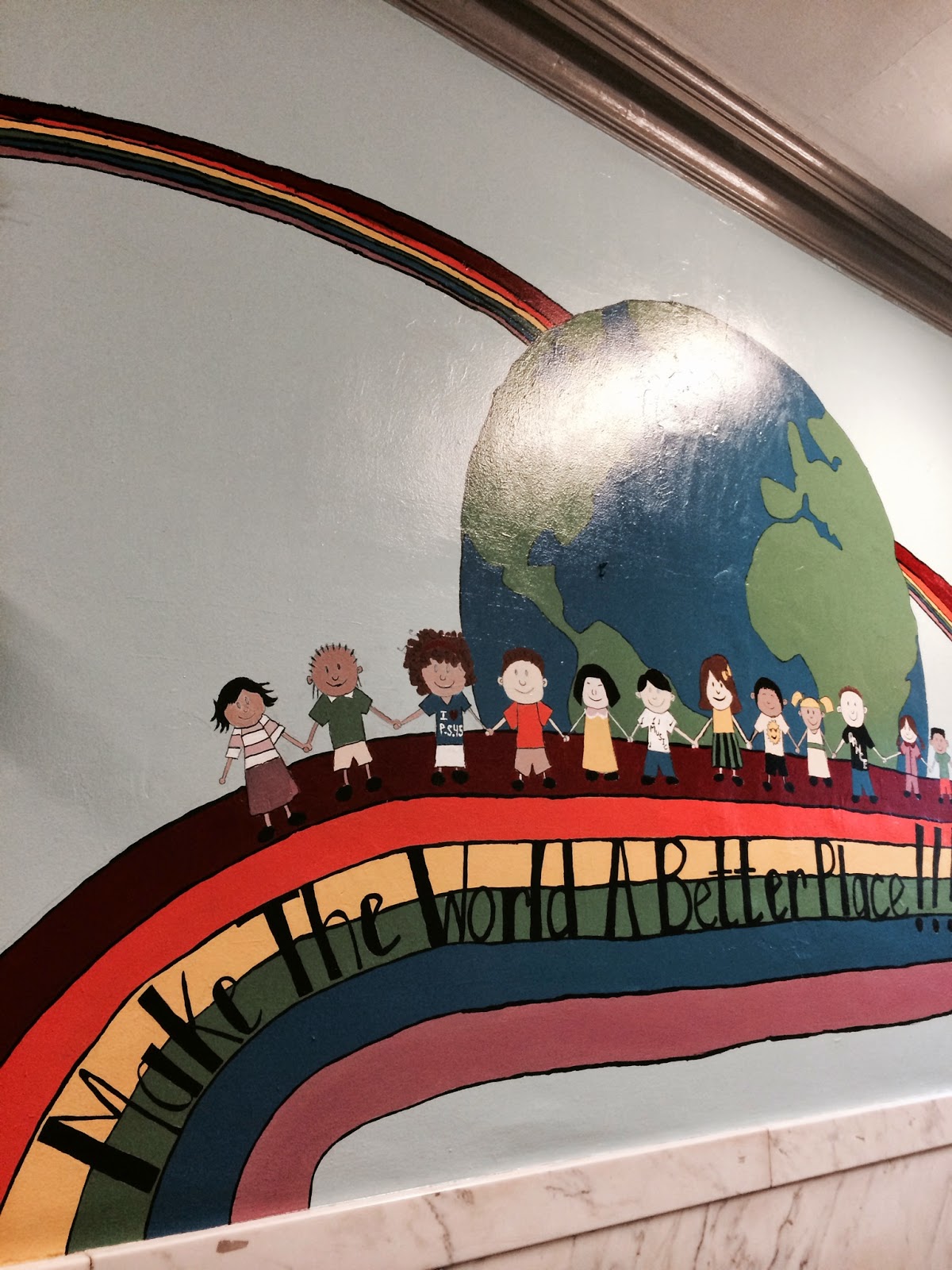


Thursday, July 3, 2014

Chain of Leadership as the Anti-Bully


The 2013-2014 school year was full of light bulb moments.

It started out with this thought:  What if we gave young students the chance to shine as leaders?  What if we spent as much time creating opportunities for them to practice their leadership skills as we did talking to them about bullying?  What if we got a little creative? What if we could inspire the adults and the kids without it being a hassle or taking away from class time?  What if we made it inexpensive?  Simple?  Flexible? And dare I say, what if it was fun?

The answer was One Can Count, based on Kathryn Otoshi's award-winning book, One, and thanks to Senator Lanza, we were able to answer some of those burning questions.

It is the first time that all 30 elementary schools in Senator Lanza's Staten Island district received the tools they needed to start their own One Can Count initiative.  It became a chain of leadership.  From the free workshop in September to the last day in June, schools made One Can Count their own.  Parent coordinators, teachers, principals and counselors embraced the concept that leadership is the anti-bully.

Here's the simple theory:  Kids need attention.  They'll get it any way they can.  So, if you give them the chance to be their best self, they most often rise to the occasion.  The more leaders you have in a classroom, the better the balance.

Although it's a children's book, every age, including grown ups are inspired by the power that each of us has to stand up and be the One that steps in.

One Can Count is designed to be a stand alone initiative or work with existing programs in the school to help children value the concept of respect.  Bullying is a tangled ball and just like any messy and complicated issue, it often requires many small solutions.

With that being said, I was amazed at what schools accomplished this year.  They took this tool and ran with it.  They had mentoring programs, art and writing projects, assemblies, leadership counsels, performances, and much more.  They created daily reminders of what it's like to be a One.

The year started out with questions but it ended with an answer:


Words of a 5th Grade Leader presenting chain of leadership to Senator Lanza:
Just like the chain, we are connected to one another in our commitment to grow into young leaders.  We are a community of learners who recognize that leadership is not just a position, but a process. -- Piumi
Part of that process:

Books and Materials  

Multiple copies of One and the companion book, Zero, were delivered to each of the 30 schools in early September.

Workshop 

With the generous support of St. John's University, schools came together to hear from experts, including author Kathryn Otoshi and to discuss ideas in which schools could easily incorporate the concepts of leadership.

Free Materials

Materials to help get the tangled ball rolling are free and downloadable here.

Creating the Concept of a Team

Schools had the option of ordering special personalized One Can Count t-shirts for students or teachers.
We're just getting started.  Next year our goal is to have every student feel like a leader. -- Parent Coordinator, P.S. 80
Sometimes it just takes One.

Thank you Senator Lanza, St. John's University, Kathryn Otoshi, and especially schools, for delivering hundreds of light bulb moments for me and hopefully Staten Island elementary school students.  Looking forward to 2014-2015.


Tuesday, April 8, 2014

Students Encouraged to Be Their "Best Selves" at P.S. 69


Our school has been placing an emphasis on exposing our students to Character Traits such as Respect, Patience, Tolerance, Responsibility, and Loyalty (just to name a few.) This emphasis shows them that truly exhibiting these traits will allow them to collaborate and communicate effectively. -- P.S. 69
P.S. 69 is keeping their eye of the prize.

Last week was big for New York schools.  Testing Week!  Administration, teachers and students gear up for this day from the first day of school.  Everything seems to lead to this ever important time.

Correction.  Almost everything.  At P.S. 69, they have a wider goal.  It's making sure that students learn how to treat each other and become their "best selves" all year round.

As part of One Can Count, sponsored by NYS Senator Lanza, every grade level and every classroom used Kathryn Otoshi's award-winning books One and Zero as a foundation to promote the concept that "Everyone Counts." (The school even involved the parents by asking the second graders to perform a play based on One for the PTA meeting.)  Although the new core curriculum has taken over and has been a time consuming focus, P.S. 69 didn't want character education to go by the wayside.

And good for them because as the Yale Center for Emotional Intelligence explains,
Our research shows that students with higher emotional intelligence are better prepared to manage their emotional lives so that they can focus, learn, and do their best in school.
Inspiring kids takes time, energy and a lot of creativity.  Hats off to ASD (Autism Spectrum Disorder) Nest Coach Stefanie Martingano, and principal Doreen E. Murphy for making sure their students gain leadership skills because leadership is the anti-bully.  Teachers get in on the act, as well, and wear their One Can Count t-shirts to remind the students that "Sometimes It Just Takes One." With the help of the staff, each student has received the message that they are a leader.

Even before the tests were finished, it was clear that this is a school full of winners.

Thursday, March 27, 2014

P.S. 45 Takes "Respect For All' Seriously All Year Long


Visiting Staten Island's P.S. 45 (John Tyler School) inspired me.  (For those reading this outside of New York City, P.S. stands for Public School.)

Every student in this elementary school participated in an awesome kick-off  assembly honoring Respect for All Week.  The students were led in a special reading of Kathryn Otoshi's book Zero by a group of their peers involved in the SOAR program.  (To facilitate character building,  New York State Senator Andrew Lanza sponsored One Can Count in all the elementary schools in his district.  Multiple copies of One and Zero were provided to each school.)

According to guidance counselor and SOAR mentor Libby McPike,

SOAR stands for Safe Organized Attitude Respect. It's our school wide positive behavior model. Kids follow these expectations and when caught doing well, can be rewarded with eagle dollars (eagle is our school mascot). Then they shop in the SOAR STORE for items anywhere from erasers to DVD players (all run on donations). 

P.S. 45's approach to teaching respect and character education is one more example to me that "leadership is the anti-bully." And sometimes teaching leadership takes a bit of creativity. Ms. Libby and her students have plenty of that to share. Here's just a snippet of the kind of activities that this dedicated professional and the students she mentors have developed to engage the entire school -- staff and students alike -- in the empowering messages of kindness, tolerance and respect. 
Monday: 
Wear Purple: Purple is the color of good judgment. It is said if you surround yourself with purple you will have peace of mind. Purple is a good color to use in meditation. Purple has been used to symbolize magic and mystery, as well as royalty. Being the combination of red and blue, the warmest and coolest colors, purple is believed to be the ideal color. 
Activity: Good Deed CatalogIt goes without saying that it’s important to teach kids to do nice things for one another. During Respect for All Week, keep a running tally of good deeds that students perform. These can include helping clean up, consoling a sad classmate, sharing, helping out a friends, etc. Tell your class that if they reach a certain number of good deeds for the week, they will receive some sort of prize (Ex. Lunch with the teacher, homework pass, Good Deed Certificate, Etc.)
On the day I visited, the gym it was an enthusiastic sea of purple. 

After reading the book, the group of SOAR students (as young as 3rd grade) led the entire school in a question and answer session based on the themes of Zero, including "What does it mean to have a hole in your middle?" and "How did it feel to have the other numbers step up?".

5 Things I Learned at P.S. 45

•    A thoughtful, creative and enthusiastic administration is the foundation for promoting high quality character education.  (A shout out to principal Ms. Chavez and parent coordinator Mrs. Poli who allowed me to be there and so graciously welcomed me to their school.)

•  It's a worthy commitment to create an environment where leadership is part of the culture year round.

•  Helping students develop leadership skills such as public speaking gives children confidence and confidence is the key to resilience.

•  When students are expected to listen to each other and value each person's opinion, they rise to the occasion.  (Note:  Amazing how many students were eager to be a part of the question/answer session.  The students obviously felt safe to share their opinions with a gym full of their peers.)

•  The students had fun.  Teaching children to step up helps children SOAR and it's never boring.

(Speaking of "stepping up," Ms. Libby went the extra step and wore purple shoes!)

Teaching leadership and respect takes a lot of hard work.  Mentoring children is exhausting and never a perfect process.  For those reasons, I am deeply grateful for the fine professionals at P.S. 45 and other schools around the country who hang in there every day and give it 100%.  You deserve a parade.

Thank you.


Thursday, January 23, 2014

Getting Creative and Teaching Leadership at P.S. 55


Students are learning that One Can Count at P.S. 55 on Staten Island.

Fifth graders are the experts as they partner with the Kindergartners to reinforce the message, "Everyone Counts."  After reading Kathryn Otoshi's award-winning book, One, the mentors got together with their younger counterparts to lead them in an activity that demonstrates that everyone is unique, beautiful and valuable.  (One is an ageless children's book which beautifully and simply inspires kids -- and adults, too -- to step up for themselves and for others.)

A One Can Count team of teachers and staff came up with the idea of doing something seasonal that expressed the importance of respecting each other's differences.  As the partners created their own snowflakes together, the students had fun getting to know one another as well as crafting something that they could display with pride.

There are so many positive things about P.S. 55's efforts.

Using a Simple Tool

NYS Senator Andrew Lanza provided 30 copies of One and 30 copies of it's companion book, Zero, to each elementary school in his district on Staten Island.  Inspired by the book and the gift, P.S. 55 set out to ensure that each student received their own personal copy of One.

Mentoring

The message of One is for all ages but when you make the older students the teachers, they take ownership of the concepts of kindness, empowerment, and positive action.  There are countless benefits of mentoring but perhaps placing students in a leadership role is the most powerful.  Leadership is the Anti-Bully.

Staff Involvement

When administration, teachers, guidance counselors, parent coordinators and other staff members get together to promote leadership, it's a message to students that they're important.  In essence, it demonstrates leadership and students learn by example.

Enthusiasm

Think about it.  Children learn more when they feel emotionally safe and when they're having fun.  The fact that Kindergartners have a friend in the 5th grade is a big deal.  Add to that, the time spent doing a creative activity brings joy to both.

Compassion

Empathy is easier to teach when students are asked to look out for someone younger.  Compassion helps students become "upstanders," the secret weapon against bullying.  When kids step up for one another in mean situations, the bullying stops in seconds.

Hats off to Principal Sharon Fishman, Guidance Counselor Arlene Donnelly, staff members Juleah Bracker and Julia Lucchese and of course and most importantly, the brilliant students at P.S. 55.  Getting creative and teaching leadership helps create a school climate of cooperation.

In other words, P.S. 55 itself is like a snowflake -- unique and beautiful.


Wednesday, December 11, 2013

Leader Nelson Mandela Was a Child Once


(AP Photo/Peter Dejong)
What counts in life is not the mere fact that we have lived. It is what difference we have made to the lives of others that will determine the significance of the life we lead.” — Nelson Mandela  
Two small stories from two different locations caught my attention this week but they had one thing in common. They were about resilient two 7-year olds who didn't give in to meanness.  As we mourn the loss of Nelson Mandela, one of the greatest leaders of all time,   the stories of Christian and Gabbie gave me hope that resilience, kindness, loyalty and bravery didn't die, too.

Second grader Christian Bucks from York, Pennsylvania, noticed that some kids feel lonely at recess.  Although, just the mere mention of recess for most children brings on euphoria, for many others, it's not so fun.  When children don't have anyone to hang out with, or worse, if they are a target for mean behavior, it feels long and uncomfortable.

Christian's simple solution?  A buddy bench.  His 7-year old instincts told him that everyone needs a safe place.

The second story is about Gabbie, a young girl from Greenwood, Indiana, with a big heart and big challenges.  Gabbie suffers from a genetic disorder, neurofibromatosis, which causes tumors to grow on the nervous system and can lead to learning disabilities.  The disease can mimic autism and result in a degree of social awkwardness.  As she became older, Gabbie started to become aware that she wasn't included in social activities, including getting invited to parties. 

Heartbroken, Gabbie's mom made an online appeal through Monkee See-Monkee Do for people to send Gabbie cards.  What happened next gave me hope that there are many little leaders out there.  Gabbie received hundreds of cards from adults and kids cheering Gabbie on and making her feel loved.

It was a gift for both the receiver and the giver.  Encouraging children to step up for others is a tremendous lesson.  To all the parents who told their children this story and pulled out the paper, pens, glue and glitter to help them write a card to Gabbie, way to go.


We have the chance to nurture great leaders.

"Sometime It Just Takes One."


Friday, November 15, 2013

Principals Have the Power to Encourage Leadership: The Anti-Bully


Leadership is not a rank or a position. Leadership is a service to be given. -- Simon Sinek
Leadership comes in all sizes, shapes, colors, and ages.  That's the message being given at P.S. 23, a wonderful elementary school on Staten Island that I recently had the privilege to visit.P.S. 23 takes leadership seriously.  As part of The Leader In Me program, each student from Kindergarten through 5th grade is taught the 7 Habits of Highly Successful People by Stephen R. Covey.Often when I walk into a school and see motivational messages on the walls, I think, "that's really nice"...but do they actually promote this to the students in a more meaningful way?  Well, I got my answer during the assembly that I led about One Can Count. (Thanks to Senator Lanza for making One Can Count available in Staten Island elementary schools.) When I asked questions about respect and stepping up for one another, I got answers like "Seek first to understand and then be understood."  Or "it's about trust."  These are sophisticated concepts for such young students, but kids are smart and when you treat them like they are, they rise to the occasion.Before the principal, Mr. Paul Proscia,  introduced me, he spoke with the children first.  He set it up by reminding them that they are all leaders.  (By the way, he was not talking to them like children.  He was talking to them like intelligent adults in the making.   It was a sea of little faces but their brains were active and engaged.)  He is helping them change the perception of leadership by explaining that leaders are everywhere --  as construction workers, business people, police officers, teachers, nurses, cafeteria workers.  "The president is a leader but you don't have to be president to be considered a leader."

Sound simplistic?  It's not.  These are messages every 5 year-old and up needs to hear in school.  Each child needs to be seen, heard and given the feeling that their unique personalities and talents make them leadership material.

At P.S. 23, they are given the opportunity to be leaders, including being a "Leader of the Month."  The rubric that decides if you get this honor is not based on grades.  It's based on showing respect, helping others, academic effort and using their talents in productive ways.

Mr. Proscia made One the Book of the Month for the entire school.  Before I even made my visit, they understood what the book was about.  It's about stepping up.  It's about being yourself.  It's about inclusion.  It's about leadership.

Why should a school make leadership and social emotional learning a priority?  The children do better in school.  That's it.  Bottom line.  They become their "best self."
Sometimes it just takes One.  
P.S. 23 is a One.


Thursday, November 7, 2013

Cyberbullying: Why We Need to Start Raising Little Leaders Online

If I have one piece of advice for every single elementary school and every single parent, it is to make teaching leadership a priority offline...and ONLINE.  Start early.

Common sense says that if we wouldn't let a child cross a street without holding their hand and teaching them the rules of the road, why would we let them loose online where there are a few dark alleys.

The discussion about technology and younger children involves what's healthy (physically) but also how very young children learn to interact with others (socially/emotionally).  If you have young children, this Huffington Post blog by Dr. Larry Rosen gives some insight to why parents should be strategic about their child's technology use.

Imagine if we could make digital citizenship a priority.  We'd all worry a little less.

This infographic by The Wired Child,  made me sit up and take notice about technology use in really young kids.

wired-child
Source: Early Childhood Education Degrees

via Early Childhood Education Degrees.com

Thursday, October 31, 2013

What a Treat: A Lesson on Trust


Since the book, One, was the Book of the Month at a local elementary school, I was asked to come talk to Kindergarten through 5th grade about how One Can Count.

In the course of the assembly, I asked "Why was it important for the other colors to step up with One?"

Many hands went up in the audience but I called on a 4th grade girl.  She looked me in the eye and said, "It's about trust."

That is not the answer I was expecting and I haven't stopped thinking about it ever since.

Trust is a fairly sophisticated concept but obviously, something that kids understand.  A school or home where trust is a priority is a safe place.  

Trick or Treat?  A lesson on trust from an 8 year-old "expert" is really a treat.


Thursday, October 10, 2013

One and Zero: Early Bullying Prevention


Dear Principals, Teachers, Superintendents, Parents and Anyone Interested in Children,

My bullying prevention tip is very fitting for today's date:  10/10, which coincidentally falls within National Bullying Prevention Month.

If you have young children or you teach young children, you'll love the award-winning book, One, and it's companion book Zero, by Kathryn Otoshi.

These books beautifully express the power of stepping up and the importance of feeling whole in your center.

They were so powerful to me that I reached out to Ms. Otoshi and we created One Can Count, which consists of materials and simple activity suggestions that support the messages of respect and leadership.   As a matter of fact, New York State Senator Andrew J. Lanza recently sponsored One Can Count in all 30 of the public elementary schools in his district.  St. John's University hosted the workshop for principals, teachers, counselors,  parent coordinators and graduate students.  As a community we came together to discuss solutions and to focus our attention on encouraging leadership skills at an early age as the anti-bully.

If you want your community to benefit from One Can Count and have questions about how to cost effectively introduce the books and materials into your school districts, contact me at thetangledball@gmail.com.

The equation is as simple as this:

Books + Free Materials + T-Shirts =  Opportunities to Encourage Leadership 

"Sometimes it just takes One."  

Thank you for being a One.

Sincerely,

Susan S. Raisch
Founder of Tangled Ball


Tuesday, April 23, 2013

Little Upstanders Make a Big Difference

Bullying prevention is complicated.  Sometimes it seems that it's bigger than all of us but it's not insurmountable.  We have an untapped army out there.  If we start training bystanders to start stepping up from an early age, we've got a shot at creating safe and caring school climates.

Read on.  We can learn from the pint-sized upstanders in this story.

I was talking to a mom of a six-year old yesterday.  Believe it or not, her first grader has been on the receiving end of true bullying behavior since Pre-K.  Everything from emotional manipulation to punching and kicking.

She admitted that in Pre-K her daughter was "a biter."  She didn't feel she could address this situation appropriately in Pre-K because she had to work on her own daughter first.  (Don't you love honest and realistic parents?) She was also a teacher before having children so she knew that what you do at home directly affects how a child acts in school.

Seems as if her own child matured beyond the biting stage but another little girl in her class didn't.  Now that they are in first grade, her little girl had already been this other girl's target for two years.  Once a light-hearted child ready and willing to go to school, my friend's daughter was having stomach aches.

The mom went to the teacher many times and although the teacher promised to keep an eye on it, the problem continued.  Like many bullying incidents, most of them were being done behind the teacher's back.

This seemed like a hopeless situation.  My friend was projecting a long and miserable school experience for her daughter.

The teacher was beginning to treat my friend like one of those moms.  She and the counselor started to blame the problem on her daughter being too sensitive.  (As my friend pointed out, anyone becomes sensitive after being mistreated for two years.)

What turned this bad situation around?  The little upstanders in the classroom.  Without "tattling," the other classmates set the teacher straight.  They told the teacher the truth.   Everything that my friend's child was trying to communicate to the teacher and counselor was true.

Then the principal stepped in.  She took the 6 year-olds at their word and the little girl was suspended for a few days. They're working on a strategy for the rest of the school year and next year.

Encouraging Our Little Bystanders To Be Upstanders  

Number One:  Make sure they know the difference between tattling and reporting.  The first is something you do to get someone in trouble; the second is telling the truth to make sure someone doesn't get hurt (emotionally or physically.)

Number Two:  Children know how to manipulate their parents.  Make sure they know that "telling" on a sibling or friend isn't cool if it's solely to get their brother, sister or friend in trouble.  Telling you about something that will be helpful to correct a situation is very different and should be encouraged.  (If you have siblings, I don't need to explain any further.  Most of us let a little jealousy get the best of us when we were kids.  That "green-eyed monster" is part of growing up but it needs to be called out.)

Number Three:  Catch them in the act of doing something good.  The children in that first grade class should be complimented for stepping up.  Of course, not at the cost of hurting their classmate's feelings (kids shouldn't be labeled as "bullies") but because they told the truth and it helped the situation.

Principals, teachers and counselors should be trained in nurturing little "upstanders."  It's called leadership.

Leadership is the anti-bully.


Wednesday, January 30, 2013

One Can Count

Watch NYOne!

New Elementary School Leadership Program Launches.  

One Can Count!

Last Friday was a good day, thanks to Senator Andrew Lanza and P.S. 5, a beautiful elementary school in Staten Island, New York.

It was a day that we celebrated leadership with Kindergartners and Fifth Graders.  These partners have been involved in the One Can Count campaign since October.  (We planned the launch for October 29th but Sandy had other plans.)  As partners, they're working on lessons of respect and having fun at the same time.

One Can Count is based on Kathryn Otoshi's award-winning children's book, One.  Like many others -- children and adults alike -- I was inspired by this beautiful book that simply and insightfully boils down the issue of bullying to numbers, letters and a meaningful message about stepping up.

I reached out to Ms. Otoshi and together we came up with ways to use One in individual elementary school classrooms or as a school-wide mentoring campaign.  Kids are the experts which is why we made them the teachers.

We hope these help you inspire your little leaders because leadership is the anti-bully.  Go to Tangled Ball.com and download the materials for free.

(A special thanks to Nancy DeMuro for getting the Tangled Ball rolling!)

Kathryn Otoshi and students share the message of One!:


Sunday, January 20, 2013

Leadership Can Be Giving Your Last Bucket of Sand or Singing A Song to Ease the Hurt


A few days after Sandy, I found this sign stapled to a poll on the beach in New Dorp, Staten Island.  It reads,
Thank you to the little girl who gave me her last bucket of sand from the beach to fill my sandbags on Sunday afternoon.  From Melissa, Millbank Rd.  
 Do some kids just have more empathy than others?  I think so...but can most kids learn empathy?  I also think so.

The more I'm in schools and just observe children, in general, I think we might be missing the boat in bullying prevention, especially with younger children.

I just finished The Leader In Me by Stephen Covey.  This is a well known school program created by the author of the extremely popular 7 Habits of Highly Successful People.

In a nutshell, The Leader In Me makes teaching leadership in school, including kindergarten and elementary school, a priority.  The result?  Less bullying issues but a lot of other benefits, too.  Schools who focus on leadership often have better test scores, experience an enjoyable school climate, happier teachers and more well-rounded students.

This makes sense to me which is why 2013 is Tangled Ball's Year of Leadership.  

Kids want to be strong.  Often, that's why they "bully."  If we teach kids to be strong by giving them real leadership skills, I guarantee there will be less mean behavior.  Who doesn't want happier, empowered kids, better test scores and less trips to the principals' office?

Giving kids chances to be leaders is the trick.  Giving adults a reason to compliment their children goes a long way to inspire kids to want to do well, including being good to their peers.

Sounds old-fahioned.  It is.  Let's bring it back anyway.

I'd love to hear your ideas on how to change our schools, ONE little leader at a time.

Speaking of leaders, here's a beautiful example of adults and kids coming together and creating a way to step up to help others feel better.  I dare you not to cry as you listen to Ingrid Michaelson (coincidentally from Staten Island) and the kids of Newtown sing "Somewhere Over the Rainbow."


Tuesday, October 2, 2012

Young Kids, Bullying Prevention and Inspiring Leaders

What perfect timing.  October is National Bullying Prevention Month and this morning I had a great conversation with an elementary school principal.  She brought up a great point.  She was worried that kids seem to react the opposite way when they host a bullying prevention assembly in the school.

She says that during the days immediately following the assembly, she gets a flood of kids coming to her telling her hat they've been bullied but  somehow, the kids it was supposed to affect -- the kids who are actually being mean -- don't get the message at all.

This is not to say that all assemblies are bad.  It's possible that the messages that experts are delivering in assemblies are getting through to a certain number of kids but how do you make sustainable change in a school?

Just as there are multiple problems complicating the bullying issue, there are multiple solutions.  When I talk about solutions, I'm talking about ways to improve the school climate.  I don't think "bullying" can be wiped out completely but I do think we can change the balance in the school to one that feels safe and somewhat nurturing.  We also have to know how to help when a child has been bullied because it will continue to happen no matter what prevention measures you put into place.  The goal is to have every child feel confident -- but they will never be totally immune to mean behavior.

I think the focus has to change from "bullying" to "leadership," especially when you're talking to kids K-8.


Last week, my friend Nancy and I went to an evening sponsored by NBC's outreach effort, Education Nation.  The topic was bullying and it was co-hosted by correspondent, Kate Snow.  One of the guest panelists was Izzy Kalman, founder of Bullies2Buddies.  He is a self-described opponent of the anti-bully movement.  His theory is that we have to start teaching kids to stand up for themselves.  He says it's the frustration of being a victim that leads to bad things -- like mass shootings and self harm.

His counterpart on the panel was Thomas Krever, Executive Director of the Hetrick-Martin Institute and although they disagreed on some of the approaches to kids being bullied, they seemed to come to a similar conclusion.

Although they didn't say it in these exact words, it comes down to teaching kids to be leaders.

Sound simple?  Simple concept and a lot of hard work to get there.  It has to start really young.  Pre-K and Kindergarten are not too early.

Leadership is the anti-bully.  If we can teach children from a young age how to be leaders,  there will be a better climate in the classroom.  A happier place leads to a more thoughtful place.  I really think all teachers and parents should read Stan Davis's book,  Schools Where Everyone Belongs.

In a way, I wish October could be We Need More Leaders month.  To that end, there are free materials and suggestions on the Tangled Ball site.  Free because it's really important that we work together to give children back their childhoods.

(By the way, I hope Kate Snow has recovered.  Ms. Snow is no stranger to news stories about bullying but I don't think she could have been ready for the raw emotions that spilled over that night.  Although kids were in the room, it was the adults that shared the most about the scars that cruel behavior has left behind.  It was a reminder why it's so important to keep going.)


Tuesday, March 20, 2012

Another Kind of March Madness


March Madness is a great time of year for me. This past weekend, there was one upset after another. My favorite team, though, survived. The U of Wisc. Badgers are still in it. (Sorry Vanderbilt fans...and stay tuned on Thursday!)

But every time I look at the news about bullying this month, I feel like it's another type of March Madness.

On any given day there are a dozen tragic stories about kids reaching out and nearly screaming for help. It's also the month that Bully will premiere in theaters (March 30th) and the "R" rating issue rages on. Cartoon Network also premiered Speak Up, with a special message from Obama. Awareness of the pain that bullying causes is gaining traction. My background is television so I've been an advocate of getting this issue more mainstreamed in the media. And boy is it ever.

So just as in the rest of life, good and bad are happening at the same time and if we're to take advantage of the good exposure it's getting, we all need to take advantage of all the great tools out there. Let's start paying attention when our kids are little. School climates depend on the type of expectations we have for our kids to treat others with kindness.

Movies wake up the country...and it's the parents, teachers, friends...and anyone witnessing meanness that help preserve the lighthearted childhoods that every single kid has a right to experience.

Bullying stops in 10 Seconds when someone steps in to stop it.

There's hope.

Wednesday, February 15, 2012

Trusted Adults Can Be the Difference Between Life and Bullycide

A new study was released regarding bullying of gay and lesbian kids and suicide. Once again, it was good to have a study to back up what we already know. Perhaps this way, people will start really paying attention to solutions.

What I want to discuss here is something that I think is key -- and perhaps hopeful -- in this tangled mess. It's the power of support from a trusted adult. From the report:

However, those who had social support -- "support from family and peers, meaning that the young person would say they have someone to go to when they have a tough time, someone is looking out for them" -- were less likely to be suicidal, Mustanski added.

Trust needs to be built over time. All kids need to learn how to communicate and share what's on their minds from an early age.

This is one of those tangled strings we can untangle if we just take the time to think about it. Raising awareness in kids and parents from Pre-K will help them in middle and high school with communication and trust. This is not to say that they won't go through the surly pre-teen and teen years but it will be easier to understand the concept of going to someone when they need help.

In middle and high school, it's even more important for adults to ignore annoying behavior and step in to ask if a child is ok. Ask and then listen. Advice may not be as important as sympathy.

Even as adults, when we suffer in silence, bad things happen. Our judgement is clouded. Our emotions run high and we go to a darker place. When someone else seems to care, it's like magic. The load gets lighter, the spirits get lifted and the power returns.


Kathryn Otoshi, the author of One, and I have talked about this gap. It's the gap of the trusted adult. If the advice we're giving to kids is to "go tell a trusted adult," and they don't have one in their lives, where does that leave them? Worse off than they were before.


(We came up with the Be the One Go-To Adult certificate and letter for elementary schools. They're free and downloadable.)

Any other ideas out there on how to inspire parents, teachers, coaches, aunts, uncles, grandparents, friends to be that Go-To Adult? Would love to hear about them and share the ideas, tools, books, etc. on this site.

Thanks -- and now go listen to a kid today! You never know what's going on inside and you might be their lifeline today.

Monday, May 30, 2011

Elementary School Graduation and Teaching Gratitude


My husband and I call this the "Season of Clapping." Between graduations and awards ceremonies, your hands start hurting.

It can also be a season of gratitude and a good time to teach kids to be thankful for the people in their lives.

As part of the Be the One leadership program at Our Lady Queen of Peace School, students in the older classes mentor the younger children on messages based on Kathryn Otoshi's award-winning book, One.

The eighth grade mentors the second graders and it's been a good partnership. They've read books, played word games, created Venn diagrams, decorated ornaments together and in general got to know each other while building a relationship of respect.

It seemed a good idea to use the eighth grade graduation as a time to teach gratitude...and who said these lessons have to be boring? As a farewell, the second graders organized a surprise party for their older counterparts. On a day that the eighth graders were off campus, the second graders went to work making cards and signs and practicing "You've Got a Friend in Me."

In the process, we were able to talk with them about gratitude. They talked about what made their Be the One partner special.

(When the seven-year olds were asked how we should fool the eighth graders in going to the party, they suggested things like, "Tell them Jesus is in the gym," or "Tell them to come look at the two-headed bird.")

When the big day came, the second graders hid on the stage and when the curtain opened they yelled SURPRISE! The eighth graders genuinely seemed happy in a "I have to still look cool" kind of way.

They ate cupcakes and drank juice and did an activity together. Using a template of a shamrock, they were asked to wish four things for each other. One of them said, "I wish you could come to high school with me to hang out."

Understanding is the anti-bully. Gratitude is the anti-bully. Really getting to know a person that you didn't know before is the anti-bully. Listening to someone younger than you and remembering what it was like to be 7 is the anti-bully. Having someone look up to you -- hanging on every word -- can be a life saver.

Introducing these concepts in the early years is One of the ways we can change the culture of mean.

Monday, March 7, 2011

When Young Kids Feel the True Meaning of Power: The Anti-Bully


You don't have to be "powerful" to stand up. Standing up will change you, change the world, and may even change the bully.

Rick Ackerly, education expert and author of The Genius in Children, offered the above comment on a recent Tangled Ball post regarding Jennifer Aniston's upstander moment.

I'm so grateful that he did because it really got me thinking about that word "powerful." As anyone knows who reads this blog, I use the book ONE, by Kathryn Otoshi as the foundation for a mentoring campaign for K-8 schools. Although technically a children's book, ONE demonstrates that some children seem to naturally know how to step up but others need to be shown. In other words, it's a teachable skill. Sometimes it's taught by an adult but my guess is that more often it's taught by example and by a peer.

Among the many reasons I love this book is that it so beautifully and simply changes the perception that only a few kids in a class are "powerful." Popularity, charisma, physical strength or aggression are not the only sources of power. Each child, if trained to step up in a way comfortable for them individually, can become empowered. When you see it in action, empowerment is no longer a buzz word. It's a joy watching kids become very comfortable in their own skin. They seem less self-conscious, more relaxed and quicker to appreciate their own voice.

His comment made me feel hopeful. Since I'm a big fan of hope in general, I reached out to "Mr. Rick," as he's known to students, to ask the following question:

When it comes to elementary school-aged children, what's your definition of 'powerful'?

My definition of a powerful elementary school child is the same as for all people, i.e someone who is skilled at defining themselves creatively, effectively and gracefully in the world. Since people are defined not only as unique entities but also by their relationships, this self-definition has everything to do with our relationships with others. Since the world is ever-changing, it is a never ending, dynamic process.

A powerful kindergartner is one who comes into the room, ready for the next challenge that their teacher or classmates dish out, someone who will see a project and make it her own whatever the given constraints. One of my favorite Ken Robinson stories is of the kindergartner who is drawing madly at his desk when the teacher comes by and says: “What are you drawing?”
K: “A picture of God.”
T: “But no one has ever seen God.”
K: “They will in a minute.”

This kindergartner is powerful. Following our genius to become our character is the everyday challenge of life from conception to death. It is also the purpose of education. Powerful people take responsibility for their relationships (100%-0, not 50-50), strive to harmonize their desires with those of others, and come across as comfortable in their own skin. For most of my career I have acted as if all people can be powerful like this and have pretty good anecdotal evidence that it’s true.

That's what I like to hear! "All people can be powerful like this." They just might need some help starting in Kindergarten.

In future posts, I'll let you know what Rick said about defining a child as a "bully" or "victim." Hint: It doesn't work so well when you're trying to nurture empowerment.